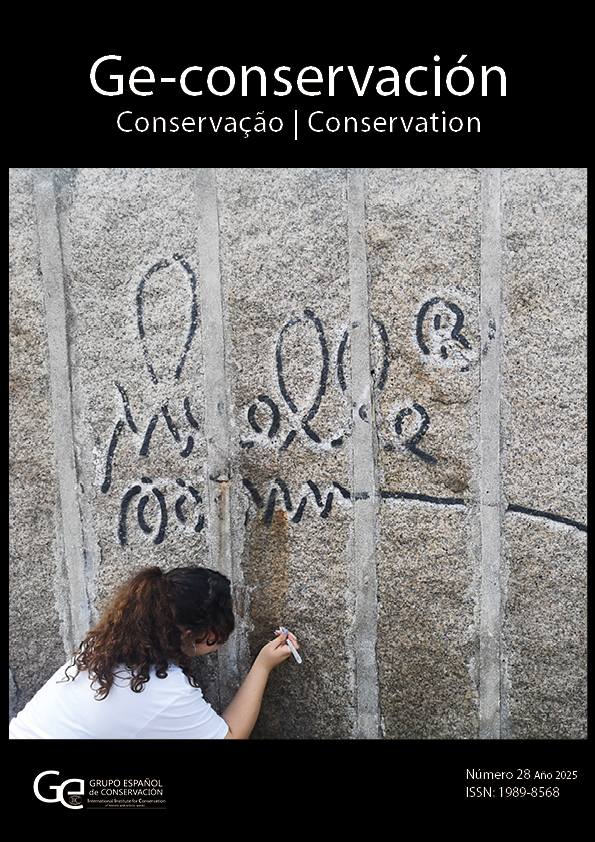
Biolimpieza de resinas acrílicas Paraloid B72 y B82: un estudio exploratorio sobre el aumento de su biodisponibilidad
DOI:
https://doi.org/10.37558/gec.v28i1.1442Palabras clave:
bacteria, biodegradación, biorremediación, limpieza, métodos innovadores de restauración, ensayos de investigación, degradación microbianaResumen
Se realizaron ensayos exploratorios destinados a incrementar la biodisponibilidad y facilitar así la biolimpieza de xenobióticos. Se evaluó la capacidad de Comamonas testosteroni, Enterobacter aerogenes y Rhodococcus erythropolis para degradar las resinas acrílicas Paraloid B72 y B82 con diferentes tamaños de partículas en medios líquidos. También se probaron Tween® 80, Tween® 20 y DMSO como agentes de pretratamiento con R. erythropolis y las partículas de resina más grandes. La degradación del Paraloid se midió por pérdida de peso, crecimiento bacteriano, potencial redox y contenido de carbono. Las partículas de resina más pequeñas parecían más susceptibles al ataque microbiano. R. erythropolis fue la bacteria más prometedora para la biolimpieza. Aunque el Paraloid B72 y el B82 tienen una estructura química muy similar, el segundo podría ser más fácil de eliminar que el primero. Tween® 80 y después, Tween® 20 parecieron aumentar la susceptibilidad de las resinas al ataque microbiano.
Descargas
Citas
ANDREOTTI, S., FRANZONI, E., DEGLI ESPOSTI, M., FABBRI, P. (2018). “Poly(hydroxyalkanoate)s-based hydrophobic coatings for the protection of stone in cultural heritage”. Materials, 11(1): 1-26. https://doi.org/10.3390/ma11010165. DOI: https://doi.org/10.3390/ma11010165
AVOGARO, V., BOSCH-ROIG, M.D.P., CASTELL AGUSTÍ, M., SANMARTÍN, P. (2025) “Biocleaning of dammar varnish from easel paintings: an experimental preliminary approach”. International Journal of Conservation Science, 16(2): 781-792. https://doi.org/10.36868/IJCS.2025.02.02. DOI: https://doi.org/10.36868/IJCS.2025.02.02
ATALAN, O. (2018). “Importance of cultural heritage and conservation concept in the architectural education”. Journal of Human Sciences, 15(3): 1700-1710. https://doi.org/10.14687/jhs.v15i3.5380. DOI: https://doi.org/10.14687/jhs.v15i3.5380
BENYAHIA, F., EMBABY, A.S. (2016). “Bioremediation of crude oil contaminated desert soil: effect of biostimulation, bioaugmentation and bioavailability in biopile treatment systems”. International Journal of Environmental Research and Public Health, 13(2): 1-11. https://doi.org/10.3390/ijerph13020219. DOI: https://doi.org/10.3390/ijerph13020219
BOSCH-ROIG, P.; ROS, J.L.R., ESTELLÉS, R.M. (2013). “Biocleaning of nitrate alterations on wall paintings by Pseudomonas stutzeri”. International Biodeterioration & Biodegradation, 84: 266-274. https://doi.org/10.1016/j.ibiod.2012.09.009. DOI: https://doi.org/10.1016/j.ibiod.2012.09.009
BOSCH-ROIG, P., POZO-ANTONIO, J.S., SANMARTÍN, P. (2021). “Identification of the best-performing novel microbial strains from naturally-aged graffiti for biocleaning research”. International Biodeterioration & Biodegradation, 159: 105206. https://doi.org/10.1016/j.ibiod.2021.105206. DOI: https://doi.org/10.1016/j.ibiod.2021.105206
BOSCH-ROIG, P., SÁNCHEZ-PONS, M., SANMARTÍN, P. (2023). “Eliminar xenobióticos del patrimonio cultural: un reto para la biolimpieza”. PH: Boletín del Instituto Andaluz del Patrimonio Histórico, 31(110): 236-250. https://doi.org/10.33349/2023.110.5387. DOI: https://doi.org/10.33349/2023.110.5387
BUSI, S., RAJKUMARI, J. (2017). “Biosurfactant: a promising approach toward the remediation of xenobiotics, a way to rejuvenate the marine ecosystem”. In Marine pollution and microbial remediation, 87-104. Springer. https://doi.org/10.1007/978-981-10-1044-6_6. DOI: https://doi.org/10.1007/978-981-10-1044-6_6
CAPPITELLI, F., TONIOLO, L., SANSONETTI, A., GULOTTA, D., RANALLI, G., ZANARDINI, E., SORLINI, C. (2007). “Advantages of using microbial technology over traditional chemical technology in removal of black crusts from stone surfaces of historical monuments”. Applied and Environmental Microbiology, 73(17): 5671-5675. https://doi.org/10.1128/AEM.00394-07. DOI: https://doi.org/10.1128/AEM.00394-07
CAPPITELLI, F., VILLA, F., SANMARTÍN, P. (2021). “Interactions of microorganisms and synthetic polymers in cultural heritage conservation”. International Biodeterioration & Biodegradation, 163: 105282. https://doi.org/10.1016/j.ibiod.2021.105282. DOI: https://doi.org/10.1016/j.ibiod.2021.105282
CATTÒ, C., SANMARTÍN, P., GULOTTA, D., TROIANO, F., CAPPITELLI, F. (2021). “Bioremoval of graffiti using novel commercial strains of bacteria”. Science of the Total Environment, 756: 144075. https://doi.org/10.1016/j.scitotenv.2020.144075 DOI: https://doi.org/10.1016/j.scitotenv.2020.144075
CHAPMAN, S., MASON, D. (2003). “Literature review: the use of Paraloid B-72 as a surface consolidant for stained glass.” Journal of the American Institute for Conservation, 42(2): 381-392. DOI: https://doi.org/10.1179/019713603806112813
FORT, R. (2007). “Polímeros sintéticos para la conservación de materiales pétreos”. In Ciencia, Tecnología y Sociedad para una conservación sostenible del patrimonio pétreo, 71-83. Spain: Ayuntamiento de San Sebastián de los Reyes. oai:digital.csic.es:10261/8340
FURUKAWA, M., KAWAKAMI, N., ODA, K.K., MIYAMOTO, K. (2018). “Acceleration of enzymatic degradation of poly(ethylene terephthalate) by surface coating with anionic surfactants”. ChemSusChem, 11(23): 4018-4025. https://doi.org/10.1002/cssc.201802096. DOI: https://doi.org/10.1002/cssc.201802096
GHARIBZADEH, F., REZAEI KALANTARY, R., NASSERI, S., ESRAFILI, A., AZARI, A. (2016). “Reuse of polycyclic aromatic hydrocarbons (PAHs) contaminated soil washing effluent by bioaugmentation/biostimulation process”. Separation and Purification Technology, 168: 248-256. https://doi.org/10.1016/j.seppur.2016.05.022. DOI: https://doi.org/10.1016/j.seppur.2016.05.022
GIOVENTÙ, E., LORENZI, P.F., VILLA, F., SORLINI, C., RIZZI, M., CAGNINI, A., GRIFFO, A., CAPPITELLI, F. (2011). “Comparing the bioremoval of black crusts on colored artistic lithotypes of the Cathedral of Florence with chemical and laser treatment”. International Biodeterioration & Biodegradation, 65(6): 832-839. https://doi.org/10.1016/j.ibiod.2011.06.002. DOI: https://doi.org/10.1016/j.ibiod.2011.06.002
LAZZARI, M., CHIANTORE, O. (2000) “Thermal-ageing of paraloid acrylic protective polymers”. Polymer, 41(17): 6447-6455. DOI: https://doi.org/10.1016/S0032-3861(99)00877-0
MOLINA, M.T., CANO, E., RAMÍREZ-BARAT, B. (2023). “Protective coatings for metallic heritage conservation: A review.” Journal of Cultural Heritage, 62: 99-113. https://doi.org/10.1016/j.culher.2023.05.019. DOI: https://doi.org/10.1016/j.culher.2023.05.019
MONCRIEFF, A., HEMPEL, K. (1970). “Biological Pack”. Work on deterioration of sculptures stone. In Conservation of stone and wooden objects, New York Conference, 2nd Ed. ICC, Ed., London, vol 1, 103-114. DOI: https://doi.org/10.1080/00393630.1971.11673769
NANTHINI DEVI, K., RAJU, P., SANTHANAM, P., DINESH KUMAR, S., KRISHNAVENI, N., ROOPAVATHY, J., PERUMAL, P. (2021). “Biodegradation of low-density polyethylene and polypropylene by microbes isolated from Vaigai River, Madurai, India.” Archives of Microbiology, 203: 6253-6265. https://doi.org/10.1007/s00203-021-02592-0. DOI: https://doi.org/10.1007/s00203-021-02592-0
ORTEGA-CALVO, J.J., STIBANY, F., SEMPLE, K.T., SCHAEFFER, A., PARSONS, J.R, SMITH, K.E. (2020). “Why biodegradable chemicals persist in the environment? A look at bioavailability”. In Bioavailability of organic chemicals in soil and sediment, 243-265. https://doi.org/10.1007/698_2020_586. DOI: https://doi.org/10.1007/698_2020_586
PETRĖNAS, T., OPUCHOVIČ, O., SENVAITIENĖ, J., BEGANSKIENĖ, A., KAREIVA, A. (2015) “A novel polymeric conservation method of historical outdoor ceramics”. Materials Science/Medziagotyra, 21(2): 293-297. https://doi.org/10.5755/j01.mm.21.2.6823 DOI: https://doi.org/10.5755/j01.ms.21.2.6823
RANALLI, G., ZANARDINI, E. (2021). “Biocleaning on cultural heritage: new frontiers of microbial biotechnologies”. Journal of Applied Microbiology, 131(2): 583-603. https://doi.org/10.1111/jam.14993. DOI: https://doi.org/10.1111/jam.14993
REICHART, O., SZAKMÁR, K., JOZWIAK, Á, FELFÖLDI, J., BARANYAI, L. (2007). “Redox potential measurement as a rapid method for microbiological testing and its validation for coliform determination”. International Journal of Food Microbiology, 114(2): 143-148. https://doi.org/10.1016/j.ijfoodmicro.2006.08.016. DOI: https://doi.org/10.1016/j.ijfoodmicro.2006.08.016
SANMARTÍN, P., CAPPITELLI, F., MITCHELL, R. (2014). “Current methods of graffiti removal: a review”. Construction & Building Materials 71: 363–374. https://doi.org/10.1016/j.conbuildmat.2014.08.093. DOI: https://doi.org/10.1016/j.conbuildmat.2014.08.093
SANMARTÍN, P., DE ARAUJO, A., VASANTHAKUMAR, A., MITCHELL, R., (2015). “Feasibility study involving the search for natural strains of microorganisms capable of degrading graffiti from heritage materials”. International Biodeterioration and Biodegradation, 103: 186-190. https://doi.org/10.1016/j.ibiod.2015.05.010. DOI: https://doi.org/10.1016/j.ibiod.2015.05.010
SANTABÁRBARA MORERA, C. (2018). “Difusión y repercusión de la teoría de la restauración de Cesare Brandi”. Cuadernos de Arte de la Universidad de Granada, 49: 285-303. https://doi.org/10.30827/caug.v49i0. 7777. DOI: https://doi.org/10.30827/caug.v49i0.7777
SEMPLE, K.T., DOICK, K.J., JONES, K.C., BURAUEL, P., CRAVEN, A., HARMS, H. (2004). “Peer reviewed: defining bioavailability and bioaccessibility of contaminated soil and sediment is complicated” Environmental Science & Technology, 38(12): 228A-231A. https://doi.org/10.1021/es040548w. DOI: https://doi.org/10.1021/es040548w
SPROCATI, A.R., ALISI, C., MIGLIORE, G., MARCONI, P., TASSO, F. (2021). “Sustainable restoration through biotechnological processes: A proof of concept”. In Microorganisms in the Deterioration and Preservation of Cultural Heritage, 235-261. Switzerland: Springer. https://doi.org/10.1007/978-3-030-69411-1_11. DOI: https://doi.org/10.1007/978-3-030-69411-1_11
TROIANO, F., GULOTTA, D., BALLOI, A., POLO, A., TONIOLO, L., LOMBARDI, E., DAFFONCHIO, D., SORLINI, C., CAPPITELLI, F. (2013). “Successful combination of chemical and biological treatments for the cleaning of stone artworks”. International Biodeterioration and Biodegradation, 85: 294–304. https://doi.org/10.1016/j.ibiod.2013.08.011. DOI: https://doi.org/10.1016/j.ibiod.2013.08.011
TROIANO, F., VICINI, S., GIOVENTÙ, E., LORENZI, P.F., IMPROTA, C.M., CAPPITELLI, F. (2014). “A methodology to select bacteria able to remove synthetic polymers”. Polymer Degradation and Stability, 107: 321-327. https://doi.org/10.1016/j.polymdegradstab.2013.12.029. DOI: https://doi.org/10.1016/j.polymdegradstab.2013.12.029
VINÇOTTE, A., BEAUVOIT, E., BOYARD, N., GUILMINOT, E. (2019). “Effect of solvent on Paraloid® B72 and B44 acrylic resins used as adhesives in conservation.” Heritage Science, 7(1): 1-9. https://doi.org/10.1186/s40494-019-0283-9. DOI: https://doi.org/10.1186/s40494-019-0283-9
WEYER, A., ROIG PICAZO, P., POP, D., CASSAR, J., ÖZKÖSE, A., VALLET, J.M., SRSA, I. (2015). EwaGlos-European illustrated glossary of conservation terms for wall paintings and architectural surfaces. (17). Germany: Michael Imhof Verlag.
WICHATHAM, K., PIYAVIRIYAKUL, P., BOONTANON, N., SURINKUL, N., VISVANATHAN, C., FUJII, S., BOONTANON, S.K. (2024). “Biodegradation of polypropylene plastics in vitro and natural condition by Streptomyces sp. isolated from plastic-contaminated sites”. Environmental Technology & Innovation, 35: 103681. https://doi.org/10.1016/j.eti.2024.103681. DOI: https://doi.org/10.1016/j.eti.2024.103681
Descargas
Publicado
Cómo citar
Número
Sección
Licencia
- Los autores conservan los derechos de autor y propiedad intelectual, y garantizan a la revista Ge-Conservación y al GEIIC el Copyright© de los derechos de edición y publicación por cualquier medio y soporte. Las obras de dichos autores además se pueden publicar bajo una Creative Commons Attribution License que autoriza ser distribuido gratuitamente, copiado y exhibido por terceros si se muestra en los créditos la autoría y procedencia original en esta revista, y no se puede obtener ningún beneficio comercial por parte de terceros, ni tampoco se pueden realizar obras derivadas.
- Los artículos podrán ser utilizados para fines científicos y formativos, pero nunca con fines comerciales, expresamente sancionado por la Ley.
- La información contenida en los artículos es responsabilidad exclusiva de los autores.
- La revista Ge-Conservación y los autores pueden establecer por separado acuerdos adicionales para la distribución no exclusiva de la versión de la obra publicada en la revista (por ejemplo, situarlo en un repositorio institucional o publicarlo en un libro), con un reconocimiento de su publicación inicial en esta revista.
- Se permite y se anima a los autores a difundir sus trabajos electrónicamente (por ejemplo, en repositorios institucionales o en su propio sitio web) después de su publicación en la revista Ge-Conservación, ya que puede dar lugar a intercambios productivos, así como a una citación más temprana y mayor de los trabajos publicados por el autor.
- Los datos personales suministrados por los autores únicamente serán utilizados para los fines de la revista y no serán proporcionados a terceros.