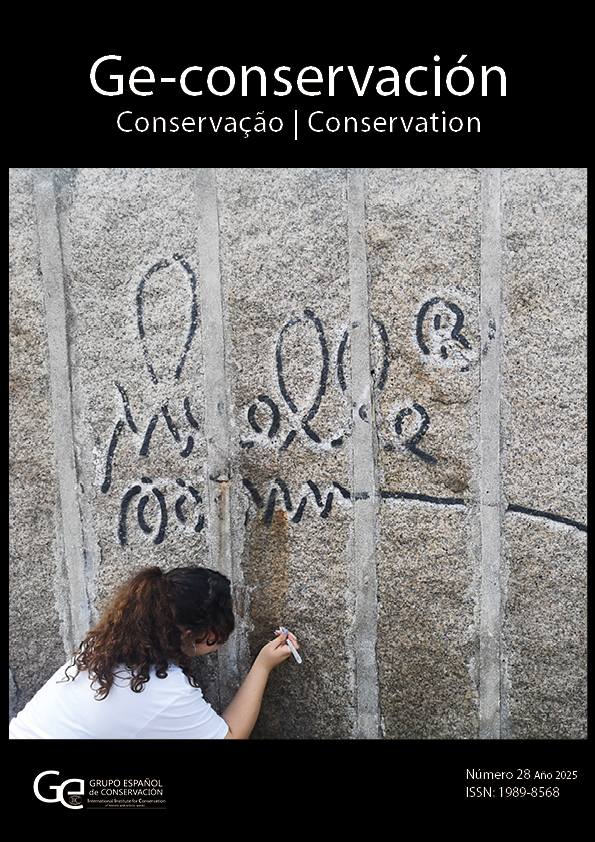
Recommendations for the removal of calcareous deposits from archaeological ceramics
DOI:
https://doi.org/10.37558/gec.v28i1.1439Keywords:
surface deposits, immersion, physical gels, chemical gels, acetic acid, nitric acid, EDTA, conservationAbstract
Since the 1970s, the removal of calcareous deposits on ceramics has been one of the most common interventions in Conservation-Restoration (CR) in Archaeology. These treatments usually involve a chemical product to reduce the hardness of the deposits, which are then removed mechanically. These procedures are still in use, despite the fact that since the end of the 1990s it has been shown that they caused serious damage to the affected pieces: changes in their composition and physical surface damage. This was the starting point of a research carried out with the aim of assessing the efficacy and safety of these treatments, including direct application methods, such as immersion, and indirect ones, such as physical and chemical gels. This work contains a series of practical recommendations derived from the research results, with the aim of bringing them closer to the CR community and improving these interventions.
Downloads
References
AENOR. (2009a). UNE 41806-1 IN Conservación de edificios Limpieza de elementos constructivos. Parte 1: Clasificación de los métodos de limpieza.
AENOR. (2009b). UNE 41806-5-1 IN Conservación de edificios Limpieza de elementos constructivos. Parte 5-1: Técnicas de limpieza química. Aplicación en forma de solución.
AENOR. (2009c). UNE 41806-5-2 IN Conservación de edificios Limpieza de elementos constructivos. Parte 5-2: Técnicas de limpieza química. Aplicación en forma de apósitos.
BERDUCOU, M.C. (1990). La Conservation en archéologie: méthodes et pratique de la conservation-restauration des vestiges archéologiques. Masson, Paris.
BUYS, S., OAKLEY, V. (1993). The conservation and restoration of ceramics. Butterworth-Heinemann, Oxford.
CAPLE, C. (2000). Conservation skills: judgement, method and decision making. Routledge, London; New York.
CARRASCOSA MOLINER, B. (2009). La conservación y restauración de objetos cerámicos arqueológicos. Tecnos, España.
CASALETTO, M.P., INGO, G.M., RICCUCCI, C. et al. (2008). “Chemical cleaning of encrustations on archaeological ceramic artefacts found in different Italian sites”. Applied Physics A, 92: 35–42. https://doi.org/10.1007/s00339-008-4519-x DOI: https://doi.org/10.1007/s00339-008-4519-x
COLADONATO, M., DI ODOARDO, B., PRUNAS, E. (2013). “Removal of Calcareous Concretions from Natural and Manufactured Stone Archaeological Artefacts through the Use of CO2 Water Solutions”. Procedia Chem 8: 65–71. https://doi.org/10.1016/j.proche.2013.03.009 DOI: https://doi.org/10.1016/j.proche.2013.03.009
FERNÁNDEZ, C., SEVA, R. (2003). “Avance al análisis de un modelo de limpieza a base de álcalis para la cerámica arqueológica”. Sautuola: Revista del Instituto de Prehistoria y Arqueología , 9: 471–482.
FERNÁNDEZ IBÁÑEZ, C. (2003). “Las sales y su incidencia en la conservación de la cerámica arqueológica”. Monte Buciero, 9: 303–325.
GIBSON, B.M. (1971). “Methods of Removing White and Black Deposits from Ancient Pottery”. Studies in Conservation 16: 18:23 https://doi.org/10.2307/1505515 DOI: https://doi.org/10.1179/sic.1971.003
GUARAGNONE, T., CASINI, A., CHELAZZI, D., & GIORGI, R. (2020). “PVA-based peelable films loaded with tetraethylenepentamine for the removal of corrosion products from bronze”. Applied Materials Today, 19, 100549. https://doi.org/10.1016/j.apmt.2019.100549 DOI: https://doi.org/10.1016/j.apmt.2019.100549
HARRISON, A. (2008). “Effects of Acid Treatment on Ceramics from Kaman-Kalehöyük”. Anatolian Archaeological Studies 18: 271–280.
HIDAYAT APRILITA, N., TRI WAHYUNI, E., MAHIRTA, et al. (2014). “Assessment of Chemical Dissolution Method for Conservation of Underwater Archaeological Ceramics”. American Journal of Applied Chemistry 2 (5). https://doi.org/10.11648/j.ajac.20140205.14 DOI: https://doi.org/10.11648/j.ajac.20140205.14
JOHNSON, J. S., ERICKSON, H.M., ICELAND, H. (1995). “Identification of Chemical and Physical Change During acid Cleaning of Ceramics”. MRS Proceedings 352: 831–837. https://doi.org/10.1557/PROC-352-831 DOI: https://doi.org/10.1557/PROC-352-831
MICHALSKI, S. (2009a). Luz visible, radiación ultravioleta e infrarroja. Roma: Centro Internacional de Estudios de Conservación y Restauración de los Bienes Culturales (ICCROM). https://www.cncr.gob.cl/noticias/agentes-de-deterioro-instituto-canadiense-de-conservacion-icc. [consulta: 15/09/2025].
MICHALSKI, S. (2009b). Temperatura incorrecta. Roma: Centro Internacional de Estudios de Conservación y Restauración de los Bienes Culturales (ICCROM) https://www.cncr.gob.cl/noticias/agentes-de-deterioro-instituto-canadiense-de-conservacion-icc. [consulta: 15/09/2025].
MINISTERIO DE EDUCACIÓN Y CIENCIA (2007). Real Decreto 1393/2007, de 29 de octubre, por el que se establece la ordenación de las enseñanzas universitarias oficiales. BOE núm. 260, de 30 de octubre de 2007, Madrid.
MORA, P., MORA, L., PHILIPPOT, P. (1984). Conservation of wall paintings. Butterworths, London.
OLIVE, J., PEARSON, C. (1975). “The conservation of ceramics from marine archaeological sources”. Studies in Conservation 20: 63–68. https://doi.org/10.1179/sic.1975.s1.011 DOI: https://doi.org/10.1179/sic.1975.011
OSCA PONS, J. (2003). “Restauración de la decoración pictórica exterior de la Iglesia de San Roque en Oliva (Valencia)”. Restauración & Rehabilitación, 75: 46–51.
PARISI, E. I., BONELLI, N., CARRETTI, E., GIORGI, R., INGO, G. M., & BAGLIONI, P. (2018). “Film forming PVA-based cleaning systems for the removal of corrosion products from historical bronzes”. Pure and Applied Chemistry, 90(3): 507-522. https://doi.org/10.1515/pac-2017-0204 DOI: https://doi.org/10.1515/pac-2017-0204
QUIROSA GARCÍA, V., GÓMEZ ROBLES, L. (2010). “El papel de la mujer en la conservación y transmisión del patrimonio cultural”. ASPARKÍA, 21: 75–90.
SÁENZ MARTÍNEZ, Á., (2022). Diseño y evaluación de tratamientos tradicionales y novedosos para la eliminación de depósitos calcáreos en cerámica arqueológica. Tesis Doctoral, Universidad Complutense de Madrid, Madrid. https://hdl.handle.net/20.500.14352/4105
SÁENZ MARTÍNEZ, Á., COLLADO MONTERO, F.J., CAPEL MARTÍNEZ, J. (2024). “Preliminary studies for the removal of carbonate deposits from painted ceramics using chemical solutions”. Conservar Património 46: 7–21. https://doi.org/10.14568/cp26050 DOI: https://doi.org/10.14568/cp26050
SÁENZ-MARTÍNEZ, Á., PÉREZ-ESTÉBANEZ, M., SAN ANDRÉS, M., et al. (2021). “Efficacy of acid treatments used in archaeological ceramics for the removal of calcareous deposits”. The European Physical Journal Plus 136: 798. https://doi.org/10.1140/epjp/s13360-021-01784-3 DOI: https://doi.org/10.1140/epjp/s13360-021-01784-3
STULIK, D., & DORGE, V. (2004). Solvent gels for the cleaning of works of art: the residue question. Getty Conservation Institute.
UNRUH, J. (2001). “A Revised Endpoint for Ceramics Desalination at the Archaeological Site of Gordion”. Studies in Conservation, 46(2): 81-92. https://doi.org/10.2307/1506839 DOI: https://doi.org/10.1080/00393630.2001.12071696
WHITE, C., POOL, M., & CARROLL, N. (2010). “Short Communication: A Revised Method to Calculate Desalination Rates and Improve Data Resolution”. Journal of the American Institute for Conservation, 49(1): 45-52. https://doi.org/10.1179/019713610804500564 DOI: https://doi.org/10.1179/019713610804500564
Downloads
Published
How to Cite
Issue
Section
License
- Copyright and intellectual property belongs to author. Author guarantees editing and publishing rights to Ge-Conservación Journal, under a Creative Commons Attribution License. This license allows others to share the work with authorship and the original source of publication acknowledgement.
- Articles can be used for scientific and educational purposes but never for commercial use, being sanctioned by law.
- The whole content of the article is author’s responsibility.
- Ge-Conservación Journal and authors may establish additional agreements for non-exclusive distribution of the work version published at the Journal (for example, on institutional repositories or on a book) with acknowledgment of the original publication on this Journal.
- Author is allowed and encouraged to disseminate his works electronically (for example, on institutional repositories or on its own website) after being published on Ge-Conservación Journal. This will contribute for fruitful interchanges as also for wider and earlier citations of the author’s works.
- Author’s personal data will only be used for the Journal purposes and will not be given to others.