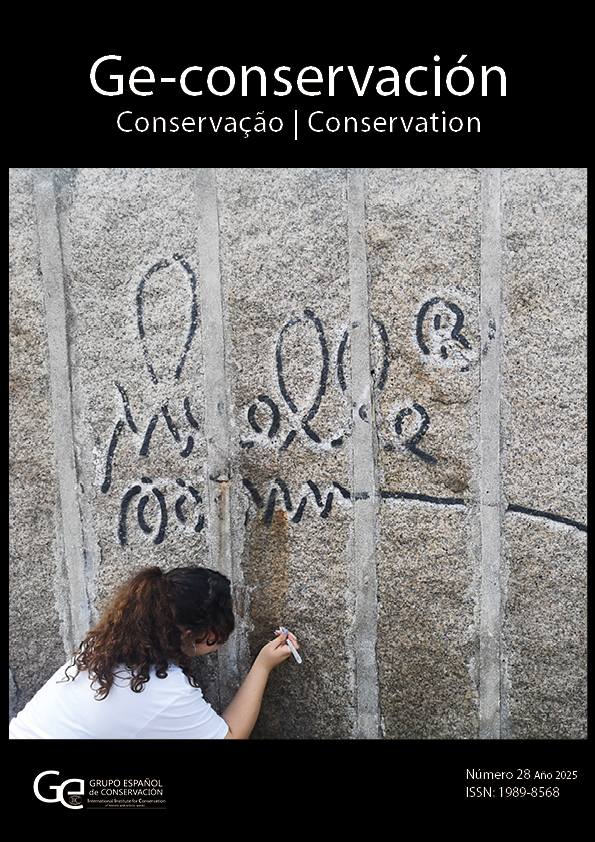
Evaluación de la tecnología láser como método de limpieza para pintura mural al temple
DOI:
https://doi.org/10.37558/gec.v28i1.1450Palavras-chave:
limpieza láser, pintura mural, Er:YAG, Nd:YAG, Nd:YVO4, conservaciónResumo
La pintura mural, al tratarse de un bien patrimonial (semi-)expuesto a diferentes agentes, sufre diferentes formas de alteración, como la aparición de depósitos, costras, etc., que pueden comprometer su estabilidad. Por tanto, las intervenciones de conservación de la pintura mural resultan esenciales para salvaguardar su significado. Desde 1970, la tecnología láser ha demostrado ser una herramienta eficaz para la limpieza de materiales usados en el patrimonio cultural. En este estudio se evalúa la aplicación de tres sistemas láser (Er:YAG, Nd:YAG y Nd:YVO4) para eliminar una capa de hollín depositado sobre muestras modelo de pintura mural al temple y envejecido de manera acelerada con exposición de SO2. Los temples usados se prepararon en laboratorio mezclando pigmentos inorgánicos con aglutinantes orgánicos, aplicando la pintura sobre un mortero de carbonato cálcico. Los resultados evidenciaron el carácter protector del aglutinante y la eficacia de diferentes estrategias láser (modificando frecuencia y/o fluencia) para eliminar la capa de hollín respetando la capa pictórica.
Downloads
Referências
ANDREOTTI, A., COLOMBINI, M.P., NEVIN, A., MELESSANAKI, K., POULI, P., FOTAKIS, C., (2006). Multianalytical Study of Laser Pulse Duration Effects in the IR Laser Cleaning of Wall Paintings from the Monumental Cemetery of Pisa. Laser Chem. 1–11. https://doi.org/10.1155/2006/39046 DOI: https://doi.org/10.1155/2006/39046
ASMUS, J.F., MURPHY, C.G., MUNK, W.H., (1974). Studies On The Interaction Of Laser Radiation With Art Artifacts, in: Wuerker, R.F. (Ed.), Developments in Laser Technology II. SPIE, 19–30. https://doi.org/10.1117/12.953831 DOI: https://doi.org/10.1117/12.953831
BACCI, M., PICOLLO, M., PORCINAI, S., RADICATI, B., (2000). Tempera-Painted Dosimeters for Environmental Indoor Monitoring: A Spectroscopic and Chemometric Approach. Environ. Sci. Technol. 34: 2859–2865. https://doi.org/10.1021/es991437d DOI: https://doi.org/10.1021/es991437d
BORDALO, R., MORAIS, P.J., YOUNG, C.R., SANTOS, L.F., ALMEIDA, R.M., (2012). Characterisation of laser-induced physical alterations of pigmented oil layers. E Preserv Sci 9: 47–59.
BRACCO, P., LANTERNA, G., MATTEINI, M., NAKAHARA, K., SARTIANI, O., DE CRUZ, A., WOLBARSHT, M.L., ADAMKIEWICZ, E., COLOMBINI, M.P., (2003). Er:YAG laser: an innovative tool for controlled cleaning of old paintings: testing and evaluation. J. Cult. Herit. 4: 202–208. https://doi.org/10.1016/S1296-2074(02)01232-3 DOI: https://doi.org/10.1016/S1296-2074(02)01232-3
BRAND, J., RODE, A.V., MADDEN, S., WAIN, A., KING, P.L., RAPP, L., (2022). Ultrashort pulsed laser ablation of granite for stone conservation. Opt. Laser Technol. 151, 108057. https://doi.org/10.1016/j.optlastec.2022.108057 DOI: https://doi.org/10.1016/j.optlastec.2022.108057
CAMAITI, M., MATTEINI, M., SANSONETTI, A., STRIOVA, J., CASTELLUCCI, E., ANDREOTTI, A., COLOMBINI, M.P., DECRUZ, A., PALMER, R., (2007). The interaction of laser radiation at 2.94 µm with azurite and malachite pigments, in: Castillejo, M., Moreno, P., Oujja, M., Radvan, R., Ruiz, J. (Eds.), Lasers in the Conservation of Artworks VIII: Proceedings of the International Conference on Lasers in the Conservation of Artworks VII (LACONA VII), Madrid, Spain, 17-21 September, 2007. CRC Press: Taylor&Francis Group, London, 253–258. DOI: https://doi.org/10.1201/9780203882085.ch40
CARDELL, C., HERRERA, A., GUERRA, I., NAVAS, N., RODRÍGUEZ SIMÓN, L., ELERT, K., (2017). Pigment-size effect on the physico-chemical behavior of azurite-tempera dosimeters upon natural and accelerated photo aging. Dyes Pigments 141: 53–65. https://doi.org/10.1016/j.dyepig.2017.02.001 DOI: https://doi.org/10.1016/j.dyepig.2017.02.001
CASTILLEJO, M., MARTÍN, M., OUJJA, M., SANTAMARÍA, J., SILVA, D., TORRES, R., MANOUSAKI, A., ZAFIROPULOS, V., VAN DEN BRINK, O.F., HEEREN, R.M.A., TEULE, R., SILVA, A., (2003). Evaluation of the chemical and physical changes induced by KrF laser irradiation of tempera paints. J. Cult. Herit. 4: 257–263. https://doi.org/10.1016/S1296-2074(02)01143-3 DOI: https://doi.org/10.1016/S1296-2074(02)01143-3
CIE S014-4/E:200, 2007. Colorimetry-part 4: CIE 1976 L* a* b* colour space. Comm. Int. Eclairage CIE Cent. Bur. Vienna.
COCOZZA, C., D’ORAZIO, V., MIANO, T.M., SHOTYK, W., (2003). Characterization of solid and aqueous phases of a peat bog profile using molecular fluorescence spectroscopy, ESR and FT-IR, and comparison with physical properties. Org. Geochem. 34: 49–60. https://doi.org/10.1016/s0146-6380(02)00208-5 DOI: https://doi.org/10.1016/S0146-6380(02)00208-5
GASPARD, S., OUJJA, M., MORENO, P., MÉNDEZ, C., GARCÍA, A., DOMINGO, C., CASTILLEJO, M., (2008). Interaction of femtosecond laser pulses with tempera paints. Appl. Surf. Sci. 255: 2675–2681. https://doi.org/10.1016/j.apsusc.2008.07.205 DOI: https://doi.org/10.1016/j.apsusc.2008.07.205
GORDON SOBOTT, R.J., HEINZE, T., NEUMEISTER, K., HILDENHAGEN, J., (2003). Laser interaction with polychromy: laboratory investigations and on-site observations. J. Cult. Herit. 4: 276–286. https://doi.org/0.1016/S1296-2074(02)01147-0 DOI: https://doi.org/10.1016/S1296-2074(02)01147-0
HERRERA, A., NAVAS, N., CARDELL, C., (2016). An evaluation of the impact of urban air pollution on paint dosimeters by tracking changes in the lipid MALDI-TOF mass spectra profile. Talanta 155: 53–61. https://doi.org/10.1016/j.talanta.2016.04.006 DOI: https://doi.org/10.1016/j.talanta.2016.04.006
MOKRZYCKI, W., TATOL, M., (2011). Color difference Delta E - A survey. Mach. Graph. Vis. 20: 383–411.
ORTIZ, P., ANTÚNEZ, V., ORTIZ, R., MARTÍN, J.M., GÓMEZ, M.A., HORTAL, A.R., MARTÍNEZ-HAYA, B., (2013). Comparative study of pulsed laser cleaning applied to weathered marble surfaces. Appl. Surf. Sci. 283: 193–201. https://doi.org/10.1016/j.apsusc.2013.06.081 DOI: https://doi.org/10.1016/j.apsusc.2013.06.081
OUJJA, M., POULI, P., DOMINGO, C., FOTAKIS, C., CASTILLEJO, M., (2010). Analytical Spectroscopic Investigation of Wavelength and Pulse Duration Effects on Laser-Induced Changes of Egg-Yolk-Based Tempera Paints. Appl. Spectrosc. 64: 528–536. https://doi.org/10.1366/000370210791211628 DOI: https://doi.org/10.1366/000370210791211628
OUJJA, M., SANZ, M., REBOLLAR, E., MARCO, J.F., DOMINGO, C., POULI, P., KOGOU, S., FOTAKIS, C., CASTILLEJO, M., (2013). Wavelength and pulse duration effects on laser induced changes on raw pigments used in paintings. Spectrochim. Acta. A. Mol. Biomol. Spectrosc. 102: 7–14. https://doi.org/10.1016/j.saa.2012.10.001 DOI: https://doi.org/10.1016/j.saa.2012.10.001
PACHECO, F., (1990). El arte de la pintura. Cátedra, Madrid, España.
Pereira-Pardo, L., Korenberg, C., 2018. The use of erbium lasers for the conservation of cultural heritage. A review. J. Cult. Herit. 31, 236–247. https://doi.org/10.1016/j.culher.2017.10.007 DOI: https://doi.org/10.1016/j.culher.2017.10.007
POULI, P., EMMONY, D.C., MADDEN, C.E., SUTHERLAND, I., (2003). Studies towards a thorough understanding of the laser-induced discoloration mechanisms of medieval pigments. J. Cult. Herit. 4, 271–275. https://doi.org/10.1016/S1296-2074(02)01207-4 DOI: https://doi.org/10.1016/S1296-2074(02)01207-4
POULI, P., NEVIN, A., ANDREOTTI, A., COLOMBINI, P., GEORGIOU, S., FOTAKIS, C., (2009). Laser assisted removal of synthetic painting-conservation materials using UV radiation of ns and fs pulse duration: Morphological studies on model samples. Appl. Surf. Sci. 255: 4955–4960. https://doi.org/10.1016/j.apsusc.2008.12.049 DOI: https://doi.org/10.1016/j.apsusc.2008.12.049
RICCIARDI, M., PIRONTI, C., COMITE, V., BERGOMI, A., FERMO, P., BONTEMPO, L., CAMIN, F., PROTO, A., MOTTA, O., (2024). A multi-analytical approach for the identification of pollutant sources on black crust samples: Stable isotope ratio of carbon, sulphur, and oxygen. Sci. Total Environ. 951, 175557. https://doi.org/10.1016/j.scitotenv.2024.175557 DOI: https://doi.org/10.1016/j.scitotenv.2024.175557
SIANO, S., SALIMBENI, R., (2010). Advances in Laser Cleaning of Artwork and Objects of Historical Interest: The Optimized Pulse Duration Approach. Acc. Chem. Res. 43: 739–750. https://doi.org/10.1021/ar900190f DOI: https://doi.org/10.1021/ar900190f
TEULE, R., SCHOLTEN, H., VAN DEN BRINK, O.F., HEEREN, R.M.A., ZAFIROPULOS, V., HESTERMAN, R., CASTILLEJO, M., MARTÍN, M., ULLENIUS, U., LARSSON, I., GUERRA-LIBRERO, F., SILVA, A., GOUVEIA, H., ALBUQUERQUE, M. B. (2003). Controlled UV laser cleaning of painted artworks: a systematic effect study on egg tempera paint samples. J. Cult. Herit. 4: 209–215. https://doi.org/10.1016/S1296-2074(02)01137-8 DOI: https://doi.org/10.1016/S1296-2074(02)01137-8
UROSEVIC, M., YEBRA-RODRÍGUEZ, A., SEBASTIÁN-PARDO, E., CARDELL, C., (2012). Black soiling of an architectural limestone during two-year term exposure to urban air in the city of Granada (S Spain). Sci. Total Environ. 414: 564–575. https://doi.org/10.1016/j.scitotenv.2011.11.028 DOI: https://doi.org/10.1016/j.scitotenv.2011.11.028
VAN DEN BRINK, O.F., EIJKEL, G.B., BOON, J.J., (2000). Dosimetry of paintings: determination of the degree of chemical change in museum-exposed test paintings by mass spectrometry. Thermochim. Acta 365: 1–23. https://doi.org/10.1016/S0040-6031(00)00609-2 DOI: https://doi.org/10.1016/S0040-6031(00)00609-2
ZHAO, B., LIANG, X., LI, T., LV, X., ZHANG, S., (2022). Impact of fuel aromatic content on soot particle physicochemical properties of marine auxiliary diesel engine. Environ. Sci. Pollut. Res. 29: 84936–84945. https://doi.org/10.1007/s11356-022-21716-7 DOI: https://doi.org/10.1007/s11356-022-21716-7
Downloads
Publicado
Como Citar
Edição
Secção
Licença
Os autores conservam os direitos de autor e de propriedade intelectual e garantem à revista Ge-Conservación o direito de edição e publicação do trabalho, sob a Creative Commons Attribution License. Este permite a partilha do trabalho, por outros, com o reconhecimento da autoria do trabalho e da publicação inicial nesta revista.
Os artigos podem ser utilizados para fins científicos e formativos, mas nunca com fins comerciais, expressamente, sancionados por Lei.
A informação existente nos artigos é da exclusiva responsabilidade dos autores.
A revista Ge-Conservación e os autores podem estabelecer, em separado, acordos adicionais para a distribuição não exclusiva da versão da obra publicada na revista (por exemplo, colocá-la num repositório institucional ou publicá-la em livro), com o reconhecimento da sua publicação inicial nesta revista.
É permitido e incentivado aos autores difundirem os seus trabalhos, electronicamente (por exemplo, em repositórios institucionais ou no seu próprio site) depois da sua publicação na revista Ge-Conservación, já que pode dar lugar a intercâmbios produtivos, assim como a citações mais amplas e mais cedo dos trabalhos publicados pelo autor.
Os dados pessoais fornecidos pelos autores são utilizados, unicamente, para os fins da revista e não serão proporcionados a terceiros.